Passive income ideas 2026 — 15 real ways to earn money while you sleep
Quick Answer:
The best passive income ideas in 2026 for beginners are digital products, affiliate marketing, and print on demand — all of which can be started for free. Passive income is not instant. Every method requires upfront work to set up. The payoff is that once the system is built, it generates income without you working more hours.
Passive income ideas 2026 — 15 real ways to earn money while you sleep
If you are working a 9-to-5 job and looking for a way out, passive income is probably the phrase that started your research. But most passive income content online is either vague ("invest in stocks!") or unrealistic ("make $10,000 a month doing nothing!").
This post covers 15 passive income ideas that work in 2026 — grounded in what is actually producing results for beginners right now. Some require a few hours of setup. Some require a few weeks. None of them require you to quit your job first, invest large amounts of money, or have any prior experience online.
The truth about passive income: you put in active work upfront. Then, if you built it correctly, it pays you while you do other things. That is the deal. It is still real — it just is not what the Instagram highlight reel makes it look like.
What passive income actually means in 2026
Passive income means income that does not require you to trade hours directly for money. Once the income stream is set up, it can generate revenue while you sleep, while you are at your day job, or while you are on holiday.
It does not mean zero work. Every passive income stream on this list requires an upfront investment of time — sometimes hours, sometimes weeks. But unlike a job, you are not paid by the hour. You are paid by the asset you built. One digital product, one piece of content, one affiliate link — each one can keep earning for months or years after you created it.
The Passive Income Reality Check:
If someone is telling you they built $5,000/month in passive income in their first week, they are leaving something out. Passive income compounds.
The first month is always the hardest. Month six looks completely different from month one — but only if you actually built something in months one through five.
15 passive income ideas at a glance
Passive Income Idea
Start Up Costs
Time to First Income
Effort Level
Sell digital products
$0
1 to 3 weeks
Medium setup, low maintenance
Affiliate Marketing
$0
2 to 6 weeks
Medium setup, low maintenance
Print on Demand
$0
1 to 4 weeks
Low setup, low maintenance
Sell AI prompt packs
$0
1 to 3 days
Low setup, low maintenance
Sell Canva templates
$0
3 to 7 days
Low setup, low maintenance
YouTube channel
$0
3 to6 months
High setup, low maintenance
Sell digital products
$0
1 to 3 weeks
Medium setup, low maintenance
Pinterest affiliate pins
$0
2 to 4 weeks
Medium setup, low maintenance
Email newsletter
$0
4 to 8 weeks
Medium setup, medium maintenance
Online course
$0
4 to 8 weeks
High setup, low maintenance
Stock photography
$0
1 to 3 months
Low setup, near-zero maintenance
Kindle / eBook publishing
$0
2 to 6 weeks
High setup, low maintenance
Membership site
$0
4 to 8 weeks
High setup, medium maintenance
Notion template store
$0
1 to 2 weeks
Low setup, low maintenance
Licence your music or audio
$0
1 to 4 weeks
Medium setup, near zero maintenance
Refer tools you already use
$0
Immediate
Zero setup, near-zero maintenance
The 5 best passive income ideas for complete beginners
Not all 15 ideas above are equal for a complete beginner with no existing audience, no technical skills, and limited time. These five stand out because they have the lowest barriers to entry, the fastest path to a first sale, and the highest potential to compound over time
1. Sell digital products
Digital products — ebooks, guides, templates, checklists — are created once and sold unlimited times. No inventory. No shipping. No customer service beyond the occasional email. You upload the file, set a price, and every sale is profit.
The best platforms to start selling: Gumroad (free), Etsy (free to list), and your own website via Systeme.io (free plan available). You do not need all three. Pick one, get your first product live, and make your first sale before expanding.
What Sells Best as a Digital Product in 2026?
How-to guides in the make money online, productivity, or AI niche. Canva templates for social media and business. Notion planners and trackers. AI prompt packs. Budget templates. Content calendars.
These are proven sellers — not because they are complicated, but because they solve a specific problem for a specific buyer.
Get the Digital Products Ebook
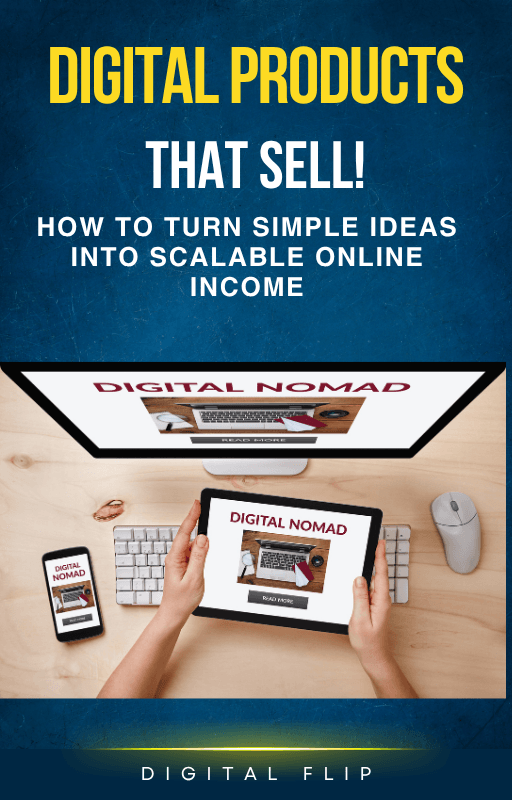
For a full breakdown of what digital products to sell and how to price them, read the Digital Products That Sell guide available in the Digital Flip Store.
ACTION STEP:
Write down three problems you know how to solve — even at a basic level. Each one is a potential digital product. Pick the most specific one and create a simple outline using ChatGPT today
2. Affiliate marketing
Affiliate marketing means recommending products you use and earning a commission every time someone buys through your link. You do not create the product. You do not handle the payment. You recommend it — through a blog post, a Pinterest pin, a TikTok, a YouTube video — and the company pays you automatically.
The highest-commission affiliate programs for beginners in 2026: Systeme.io (40% recurring monthly), Canva Pro ($36 per annual signup), Printify (up to $25 per referral), and ClickBank (50–75% per sale on digital products).
For the full step-by-step breakdown, read Day 1 of the Digital Flip blog: How to start affiliate marketing for beginners in 2026.
Get the Affiliate Marketing Unlocked Ebook
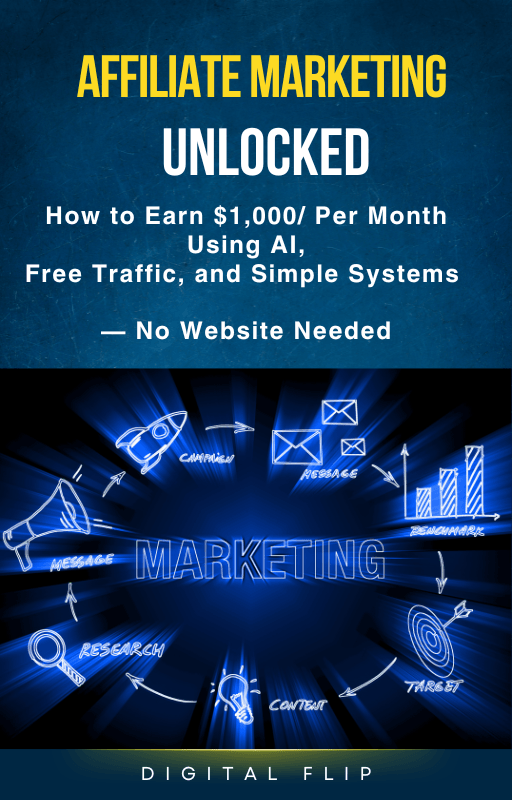
For a full breakdown of what affiliate marketing is and how it runs, get the Affiliate Marketing Unlocked Ebook accessible here.
ACTION STEP:
Follow this link to systeme.io affiliates. Sign up for free to become an affiliate. Get your unique affiliate link. That link can start earning you 40% recurring commissions today — every month a referred customer keeps their subscription.
3. Print on demand
Print on demand means you upload a design to a platform like Printify or Printful. When someone buys a product featuring your design — a t-shirt, a mug, a tote bag, a phone case — the platform prints it, ships it, and handles the customer. You collect the profit margin without ever touching the product.
The startup cost is genuinely zero. Printify has a free plan. Etsy lets you list for $0.20 per item. Your entire setup cost for a print on demand store is under $1 if you list five products. You use Canva (free) to create the designs and ChatGPT to generate niche ideas and product descriptions.
PRINT ON DEMAND NICHE STRATEGY:
Generic designs do not sell. Niche designs do. Instead of "funny cat t-shirt" (millions of results), try "funny t-shirt for female accountants" or "gift mug for dog moms who do yoga." The more specific the niche, the less competition, the easier the sale. ChatGPT can generate 50 niche ideas in two minutes — try: "Give me 50 specific niche ideas for print on demand products targeting professionals or hobbyists."
ACTION STEP:
Open Printify and create a free account. Connect it to a free Etsy store. Create and list one product in a specific niche this week. That is your print on demand business started.
4. Sell AI prompt packs
AI prompt packs are collections of curated, tested prompts for a specific use case — sold as a downloadable PDF or Notion document. They are one of the easiest digital products to create in 2026 because the tool you are selling prompts for is the same tool you use to build the product.
Price range: $10–$30. Time to create: 2–4 hours for a quality 50-prompt pack. Platform: Gumroad or Etsy. Promotion: Pinterest pins linking directly to the product page, or a short TikTok showing the prompts in action.
The Digital Flip AI Prompts Bundle is a live example of this product — you can see it at digitalflip.org/ai_prompts_bundle. For a full guide on building and selling with AI, read Day 2 of this blog: How to make money with ChatGPT as a complete beginner.
ACTION STEP:
Spend 30 minutes in ChatGPT testing prompts for one specific niche. Save every prompt that gives genuinely useful output. After 30 minutes you have the foundation of a $15 product.
5. Canva templates
Canva templates are pre-designed layouts that buyers purchase, open in Canva, and customise with their own text, colours, and images. They sell on Etsy and Gumroad and are one of the top-performing digital product categories in 2026.
What sells well: Instagram carousel templates, Pinterest pin templates, resume templates, pitch deck templates, media kit templates, and invoice templates. You design them once in Canva, share the link, and every buyer gets their own editable copy. Zero fulfilment. Zero inventory.
CANVA TEMPLATE PRICING:
Individual templates: $3–$8. Template bundles (10–20 templates): $15–$35. Full brand kit bundles: $25–$65. Start with a bundle of five related templates in one niche — for example, five Instagram carousel templates for small food businesses. Price at $15. List on Etsy.
ACTION STEP:
Open Canva. Create one Instagram carousel template in a niche you understand. It does not need to be perfect — it needs to be done. Save it, turn on link sharing, and you have a sellable product.
Passive income ideas with little money — what to prioritise
If you have $0 to invest, prioritise ideas 1–5 above. Every single one of them is genuinely free to start. The only investment is your time.
If you have $10–$50 to invest, consider:
Etsy listing fees — $0.20 per listing. For 10 digital products, that is $2. Worth it for the built-in search traffic Etsy provides.
A custom domain name — $10–$15 per year from Namecheap or Hostinger. Not required to start, but worth adding once you are generating your first income.
Canva Pro — $13/month. Access to premium elements, background remover, and brand kit. Invest in this once your Canva templates start selling — not before.
Systeme.io paid plan— $27/month. Unlocks more funnels, email contacts, and automation. The free plan covers everything you need and is free forever but with limited features.
The biggest mistake people make with low-budget passive income is spending money on tools before they have proven the model. Start with free. Earn your first $50. Then reinvest
Low Budget Rule:
Zero-cost tools first, always. Gumroad is free. Etsy lists for $0.20. Systeme.io has a free plan. Canva is free. Pinterest is free. TikTok is free. You can build a functioning passive income system with $0 — and most people should, before spending a single dollar.
Online passive income ideas — choosing the right platform
The platform you choose matters less than the consistency you bring to it. That said, not all platforms are equal for beginners building passive income in 2026.
Here is where to focus based on your strengths:
1. Pinterest — best for digital products and affiliate marketing. Pins compound in value over time and appear in Google search. Each pin is a 24/7 salesperson. Beginner-friendly, no face required, works with a free Canva account.
2. TikTok — fastest organic reach of any platform in 2026. Best for beginners comfortable on camera or creating screen-share content. Short videos (30–60 seconds) driving traffic to a link in bio. High potential for viral traffic spikes.
3. Etsy — built-in search engine with buyers already looking to spend money. Best for digital downloads, Canva templates, and print on demand products. Low competition for niche products. Works immediately without an existing audience.
4. Gumroad — direct sales platform for digital products. No Etsy algorithm to fight. You bring your own traffic through social media or email. Best used alongside a content platform rather than as a standalone store.
5. Email list (Systeme.io)— the most valuable long-term asset. One email to 1,000 subscribers can generate $500–$2,000 in a single send. Takes longer to build than social media but converts far better. Start building from day one.
The optimal beginner strategy: pick one social platform (Pinterest or TikTok), one product platform (Etsy or Gumroad), and one email tool (Systeme.io free plan). Drive traffic from social to your products. Capture emails along the way. That is the passive income engine in its simplest form.
ACTION STEP:
Write down which one social platform and which one product platform you will focus on for the next 30 days. Commit to that combination and ignore everything else until you have made your first 10 sales.
How AI tools are changing passive income in 2026
AI tools — particularly ChatGPT and Canva — have dramatically reduced the time it takes to build passive income assets. What used to take weeks now takes hours. What used to require hiring a designer or writer can now be done by a single person with no specialist skills.
Specifically, AI is changing passive income in three ways:
Faster product creation. ChatGPT can draft an ebook in hours. Canva's AI tools can design graphics in minutes. The time cost of creating digital products has dropped by 80–90% compared to five years ago.
Better content at scale. Creating 30 Pinterest pins, 7 social media captions, and a blog post used to take days. With AI assistance, it takes hours — which means more traffic, more affiliate links in circulation, and more passive income potential.
AI as the product itself. Prompt packs, AI workflow guides, and ChatGPT training resources are now among the best-selling digital products on Etsy and Gumroad. The tool people are trying to learn how to use is itself the most valuable thing you can teach.
AI PASSIVE INCOME STARTER PACK
1. ChatGPT (free) to write, research, and create product content.
2. Canva (free) to design covers, templates, and pins.
3. Gumroad or Etsy (free to start) to sell.
4. Systeme.io (free plan) to capture emails and automate follow-ups.
5. Pinterest and TikTok (free) to distribute.
Total cost: $0.
Total setup time for first product: 3–5 hours.
4 passive income mistakes that slow beginners down
1. Treating passive income as instant income. It is not. The first 30–60 days are always the hardest. You are building the asset, not earning from it yet. Expect slow initial results. They are normal.
2. Spreading across too many ideas at once. Choose one idea, build it properly, and make your first sale before adding a second stream. Running five half-built passive income streams produces almost nothing — one fully-built stream compounds.
3. Not capturing emails from day one. Social media following can disappear overnight if a platform changes its algorithm or bans your account. Your email list is the only audience you actually own. Start building it from your very first piece of content
4. Waiting for the perfect product. Good enough and live beats perfect and never published every single time. Your first product will not be your best product. Publish it anyway. Use what you learn to improve the second one.
Frequently asked questions
How much can you realistically make from passive income as a beginner?
In months 1–2, most beginners earn $50–$300. By months 3–6, with consistent content creation and a growing product range, $500–$1,500/month is realistic. Scaling to $3,000–$5,000+/month is achievable by month 6–12 with multiple income streams compounding. These are realistic averages, not guarantees — results depend entirely on consistency and execution.
Do passive income ideas work in Africa and developing countries?
Yes — digital products, affiliate marketing, and print on demand all work regardless of location. Platforms like Gumroad, Etsy, and Printify accept sellers worldwide. Payment is via PayPal or bank transfer. The audience you sell to is global, not local, so your geographic location does not limit your income potential.
How long does it take to build real passive income?
Most people see their first $100/month within 60–90 days of focused effort on one income stream. Building to $1,000+/month typically takes 4–6 months. These timelines assume consistent weekly content creation, one or more products live, and an email list being built from day one.
Is passive income taxable?
Yes — in most countries, passive income from digital products, affiliate commissions, and online sales is taxable as self-employment or business income. Keep records of all income and expenses from the start. Consult a local tax advisor once you are earning consistently. This post does not constitute tax advice.
Written by Digital Flip
Digital Flip is a digital products brand dedicated to helping complete beginners and 9-to-5 workers build sustainable online income. We cut through the noise, skip the theory, and deliver practical tools you can act on today. Explore our full product range at digitalflip.org/store.
SHARE